The original nerve-signalling explanation, threshold and synapse-count figures have not received current scientific review.
A postsynaptic terminal is the receiving part of the connection (synapse) between two nerve cells (neurons). Here is a diagram of a synapse showing where the postsynaptic terminals are typically located:
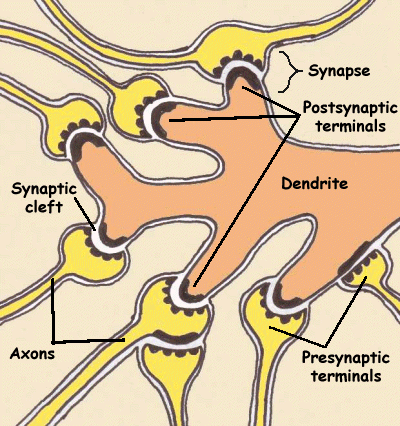
When a nerve impulse (action potential) reaches the presynaptic terminal of the sending neuron it releases small signalling molecules called neurotransmitters. These migrate to the postsynaptic terminal across a small space between the two synaptic terminals called the synaptic cleft.
The surface of the postsynaptic terminal is known as the postsynaptic membrane and has receptors sites for neurotransmitters. Depending on the type of neurotransmitter and the receptor, the response may either be
excitatory - to make the initiation of an action potential in the receiving neuron more likely or
inhibitory - to make the initiation of an action potential in the receiving neuron less likely.
Triggering an action potential is not an on/off system - the net effect of excitatory neurotransmitters take away the effect of the inhibitory neurotransmitters must reach -55 millivolts for it to happen.
A typical neuron in the central nervous system (CNS) has around 100,000 synapses.
Neurotransmitters do not stay in the receptors forever and are deactivated in a number of ways. This means that the threshold needs to be achieved within a time period before too many neurotransmitters become deactivated.
Both synaptic terminals play major roles in deactivating neurotransmitters. The presynaptic membrane reabsorbs them for later reuse (reuptake) and the postsynaptic membrane produces enzymes that break them down. A few neurotransmitters drift out of the synaptic cleft altogether.
Postsynaptic terminal links:
Neurotransmission - Chemical Communication
Source details
Author: Paul Jones
Archive capture: . This is not a medical review date.