The original transplantation, immune-system and genetic descriptions have not received current scientific or medical review. The gene table is the original simplified historical representation, not a current genetic reference.
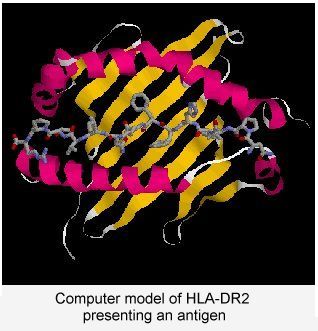
The Major Histocompatibility Complex (MHC) is a group of genes that, in humans, code for a complex of cell surface proteins called the Human Leukocyte Antigen (HLA). The word "Histocompatibility" comes from "histo" meaning tissue and "compatible". Any two people with the same MHC have compatible body tissue which means that skin and organs from one will be compatible for transplant into the other. Our immune systems will reject tissue from people with different MHCs. Most cells in the body express MHC proteins.
In humans, MHC is equivalent to HLA and performs two essential immune system functions:
Antigen Presentation which involves presenting broken down protein segments (antigens) to certain immune system cells (T Cells) which determine whether they belong to self or non-self tissue.
Releasing some of the messenger molecules that mediate the inflammatory response (cytokines) and other proteins that contribute to that response (complement).
I want to concentrate on the Major Histocompatibility Complex in a little detail because it is implicated in multiple sclerosis in two important and closely linked ways:
MS is believed to be an autoimmune disease in which the immune system attacks the body's own tissue and MHC provides the mechanism whereby the immune system determines what is the body's own tissue.
The genes most consistently associated with multiple sclerosis are found in regions of the MHC.
There are three classes of MHC:
MHC class I
These proteins are expressed on almost all cells in the body. In fact, each cell will express around 100,000 MHC class I molecules. Protein fragments (antigens) are transported from inside the cell where they are held like a sausage in a hot dog. The MHC class I binds to a type of immune system cell called a killer (cytotoxic) T cell and "presents" the captured antigen to it. If the killer T Cell's receptor matches the captured antigen, it will mount an attack on the presenting cell, destroy it with toxic enzymes (lysis) and tell it to kill itself (apoptosis). In this way, killer T cells keep virus-infected or malignant cells in check.
MHC class II:
These proteins are expressed on cells of the immune system called antigen presenting cells (APC). Examples of APCs include Dendritic Cells, Macrophages, B Cells, Neutrophils and Mast Cells. Part of the function of these cells to engulf dead cells and other material and break it down into antigens. These antigens are then presented to helper T cells via MHC class II in much the same way that antigens are presented to killer T cells via MHC class I as described above.
When the Helper T cell's receptor matches the antigen, it becomes activated and initiates the body's immune response which includes initiating antibody production, activating killer T cells and releasing messenger molecules, called chemokines, which summon a variety of other immune system cells (leukocytes) to the site of the infection.
MHC class III:
MHC class III proteins are a diverse group of molecules that perform a variety of functions in the body. They include complement proteins which are involved in the antibody response, the inflammatory cytokines, tumour necrosis factor-α and -β (TNF-α and -β) and two heat shock proteins which help cells deal with heat, stress and viral infection.
Here is a simplified diagram of the human MHC genes located in a single stretch on the short arm of chromosome 6:
Complex | HLA | ||||||||||||
|---|---|---|---|---|---|---|---|---|---|---|---|---|---|
MHC class | II | III | I | ||||||||||
Region | DP | DM | DQ | DR | C4, C2, Hsp70, BF | B | C | E | A | G | F | ||
Gene Products | DP αβ | DM αβ | DQ αβ | DR αβ | Complement proteins | Heat Shock Proteins | TNF-α TNF-β | HLA-B | HLA-C | HLA-E | HLA-A | HLA-G | HLA-F |
Major Histocompatibility Complex links:
Source details
Author: Paul Jones
Archive capture: . This is not a medical review date.